Did an interview on facing death as a Christian, and other matters.
Friday 1 December 2023

Thursday 20 July 2023
How are you?
When I first got diagnosed with stage IV bowel cancer I was quite surprised that medical receptionists would routinely say to me, as I walked in to my appointment, “Hi, how are you?”
I was tempted to respond “Well given that you’ve got my diagnosis open on the screen in front of you, and given that you’ve probably seen a heap of patients in my situation, maybe you should tell me?”
Or even, "What do you mean? I'm dying. And how are you?"
But despite the testimony of my wife, I'm not quite that unkind.
Current situation: God is kind, I am well, no evidence of tumour growth for quite a while now. Treatment projected to be lifelong, side effects have been minimal.
Anyway. How are you?
(Oh, and it's good to be kind to receptionists. The correct answer is "Good thanks. How are you?")
Monday 26 December 2022
Happy Christmas. There weren't three kings.
Happy Christmas to all. There weren't three kings. Here's a sermon I preached on that yesterday on Christmas Day, from about the 40 minute mark.
But really, happy Christmas. May God bless you and keep you.
Tuesday 13 December 2022
Cancer remission, radioactivity, and hope
Greetings all.
Yes, I am in remission as mentioned in the previous post. This is the truth, and God is good!
But. as also mentioned, that doesn't mean a complete cure (something doctors are a bit wary of declaring).
Remission as I understand it can be either partial or complete. Complete remission is being cured. Partial remission is what I'm in, which is still most excellent. Technically it means that the original tumours are undetectable and have remained so after a period of thirty days.
However, new cancer activity is not unusual.The radiation oncologist tells me that it is like when you have a nest of rats in your house that you eliminate by poisoning all of them. One or two survive, and if they survive, they may re-establish a new colony. So the best thing to do is find another way to kill them as well.
This seems to me a fairly non-technical explanation but it does make sense, yes?
In my case, radiation doc tells me that this means five short sharp blasts of radiation, of which my first happened yesterday, my second happens tomorrow, my third happens on Friday, then we go Monday and Wednesday of next week.
I wanted to ask to hire the radiation gun and then just see if I couldn't treat myself at home.
Anyway that is what we're up to, the previous good news remains great news and we continue.
Meanwhile here's a sermon I preached on Sunday on the topic 'Anxiety and depression'. Pick it up at about the 44 minute mark. Some stop-start glitchiness but it does work.
Friday 2 December 2022
Remission
I had some good news this week. My oncologist, having considered the PET scans from the previous Friday, was ready to say for the first time that my cancer is "in remission".
This doesn't mean it's gone, but it does mean that it's going. In fact, there's nothing of the original cancer tumours that remain at any detectable level. There is a small lesion--new activity--in the liver, that I'm seeing a radiotherapist about today to decide on the next best step.
But the current big picture is that I was diagnosed with Stage IV bowel cancer on 6 January this year, and now there's almost nothing to be found. Family are pretty happy, as am I. Who knows what will happen next? God does, and this is his plan for our good and his glory.
In the meantime, Christmas approaches. If you care to sing carols with our church on 18 December, then come along. God is good!

And, a Bible verse:
And we know that for those who love God all things work together for good, for those who are called according to his purpose. (Romans 8:28)
This is not about us (none of it, at any time). It is about our great God and Saviour, the Lord Jesus Christ.
Saturday 12 November 2022
Will I make it to the end? A sermon from Hebrews 7
Last Sunday I preached on Hebrews 7, 'Will I make it to the end?' You could also call it 'International Man of Mystery'. Key verse:
Consequently, [Jesus] is able to save to the uttermost those who draw near to God through him, since he always lives to make intercession for them. (Hebrews 7:25)
Tuesday 1 November 2022
A carrot, a stick, and entering God's rest
I preached a sermon recently about entering into God's rest, wuth carrot and stick. You can hear it from about the 23 minute mark.
A podcast interview: cancer and mission
I recently did an interview with a good friend, Mark Peterson, about cancer and mission.
Mark Peterson is the director of the Church Missionary Society in South Australia and the Northern Territory and he wanted to ask me about both topics.
About half an hour of listening; you can find the podcast here.
In it I refer to these Bible verses, 2 Corinthians 4:17-19:
So we do not lose heart. Though our outer self is wasting away, our inner self is being renewed day by day. 17 For this light momentary affliction is preparing for us an eternal weight of glory beyond all comparison, 18 as we look not to the things that are seen but to the things that are unseen. For the things that are seen are transient, but the things that are unseen are eternal.
And hey, if you've got the mood for listening to more, then the slightly longer--and much more marvellous than me--St Matthew's Passion is here:
Or if you can only spare 60 seconds, my favourite section is this repeated theme. (Beloved Jesus, what has thou done wrong That they have pronounced so hard a sentence? What is thy guilt, into what sort of misdeeds Hast thou fallen?)
Oh and cancer treatment continues very well. Stamina increasing. No news is good news. Oncologist (whom I saw today) remains very happy.
Tuesday 9 August 2022
I preached a meaningless sermon.
I preached a meaningless sermon on Ecclesiastes 6-10.
You can see it here from about the 33 minute mark.
Oh and the cancer treatment is still working fine, as far as me and my oncologist can work out.
Wednesday 20 July 2022
God loves a cheerful oncologist (20 July)
Actually the saying is that 'God loves a cheerful giver' (2 Corinthians 9:7)
But in my case a cheerful oncologist is the next best thing. Last catch-up we had was last week. He asked about nausea, skin rashes, general plumbing functioning, fatigue, and made an appointment for mid-August. Told me everything was going well, just keep taking the medication and getting the treatment and we would see how things continued to progress. Not even the need for a scan.
So that's all good and if you've only just logged on to discover the latest...that's pretty much it!
But let me not pass up the opportunity to link to my sermon on Ecclesiastes 2 from a couple of weeks ago; I appear at about 24 minutes and 30 seconds.
Or, for those who prefer melancholy and pain to cheeriness, here is a marvellous Johnny Cash version of 'Hurt':
Wednesday 6 July 2022
Another meaningless sermon (not a cancer update)
I preached another meaningless sermon. Why meaningless? Listen from about 25 minutes, here:
https://youtu.be/oFf8QZDFPIQ
Thursday 30 June 2022
Prayer, miracles and medicine (cancer update 30 June)
The news from my oncologist continues to be good. He is pleased with the progress of my cancer treatment, which he says is in the top 1% of positive responses. I've not had any bad nausea or side-effects and that's great. At the moment it's just keep going with taking tablets and getting a fortnightly infusion of medication, previously weekly. So our family continues to thank God and I continue to avoid crowds (COVID and flu are never good companions at the best of times).
As anyone who's had contact with cancer knows, good news can turn into bad news quite suddenly, so we here in the house of Cheng are not being complacent about what the future may hold. It is a matter of daily trusting in God's goodness, whatever happens.
Is this a miracle? It feels like it. Yet I hesitate to use such language. Partially at least this is because any improvement comes in clear response to the latest medical treatment, and the extraordinary privilege of having such treatment close to hand and significantly subsidised by the Australian government and administered by amazingly gifted and hardworking medical professionals.
Mainly I would want to insist, along with anyone who reads their Bible carefully and trusts what it says, that God is in control of the smallest detail of life. That includes the efficacy of any medical treatment, and the response of the body he has created to that treatment. To suggest that some good response to cancer treatment is not a miracle is in no way to detract from the power, sovereignty and goodness of God. Rather the opposite. The fact that he controls both the extraordinary and the mundane, the eternal and the quotidian, the miraculous and the daily detail of life--all of this is to credit greater power and authority to his name. He does not merely control the freakish event, and leave the rest of his creation to roll on largely disregarded. Matthew 10 says this:
Are not two sparrows sold for a penny? And not one of them will fall to the ground apart from your Father. 30 But even the hairs of your head are all numbered. 31 Fear not, therefore; you are of more value than many sparrows. 32 So everyone who acknowledges me before men, I also will acknowledge before my Father who is in heaven, 33 but whoever denies me before men, I also will deny before my Father who is in heaven. (Matthew 10:29-33)
Indeed the extent of God's power and authority over our lives gives us grounds for an even greater (and right and proper) fear of what he is able to do. That same passage says, in the previous verse "And do not fear those who kill the body but cannot kill the soul. Rather fear him who can destroy both soul and body in hell." (Matthew 10:28)
He is a good God, and a loving God who would gladly give his own Son to death on a cross to reconcile us to his eternal grace. Yet alongside this he is a holy God with the power to cause or cure cancer, and use all events for our good and his glory. One day we will face him as judge. May we also cling to him as our Saviour; whether from cancer or a far worse fate. And may we joyfully rejoice that he is inclined to save us not only from cancer but from our sin.
****
Ja sorry about font and background colour madness. I'm having trouble figuring it out. Here for your consolation is a sermon I preached on Sunday, the best sermon (from me) on Ecclesiastes 1 you will ever hear, unless you heard the one I preached before that on the same passage or maybe someone else's sermon. There's a Bible reading from about the 35 minute mark followed by talk.
Thursday 2 June 2022
Short memory...must have a short memory (not a cancer update, 2 June)
Not a cancer update but too good a story not to record here. (Oh, the cancer treatment seems to be progressing well although in the last two days I've had a return of nausea).
Yesterday I'd organised to borrow my dad's car to get to my cancer treatment. Went to get it out of the carport--gone! After discussion with my dad he reported it as stolen. But who steals a keyless entry boring white suburban Mazda sedan with a scrape mark on its side? A complete mystery, and he asked the neighbours for help to no avail.
Today the same neighbour that he first asked said they'd found the car in the local Woolworth's carpark. Now I swear I have no memory of this even as I describe it, but apparently I drove down to the shops to buy some food for dinner, got the food, forgot that I'd driven the car and walked back to my dad's.
Thank God for good neighbours eh. Who knows how long the car could have stayed in the Woolies carpark otherwise.
This is now the third time in my life I've 'lost' a car in similar circumstances. In 2009 I lost a car in Top Ryde carpark and a nice security man picked me up and drove me around until we found it. I once went to a choir rehearsal, came back to where the car was, found it was missing and reported it stolen. Only to find it about 200 metres from where I thought I'd parked it.
I remember hearing, of all people, Brian Houston (ex-Hillsong) speaking of driving to a supermarket, not finding his car, reporting it stolen, collecting insurance etc. Six months later he returns to the same supermarket, looks over to the car parked next to his, and realises that it's the car he reported stolen six months earlier.
The incident recounted by Brian is one I heard in 2007. But I still have no memory of driving to the shops on Monday. Short-term memory loss anyone? I will tell my oncologist and he can tell me if it is a side-effect of treatment, in which case I guess this is a cancer update. But somehow I am doubting that.
Anyway here is another song I recall from a long time ago that somehow seems to relate:
In the meantime, move along folks. Nothing to see here. At least as far as I can recall.
Wednesday 18 May 2022
I have good news and a broken bone (Cancer update 18 May)
I have good news and a broken bone. The two are not unrelated.
The good news, in fact great news, is that I had a PET scan yesterday with results delivered at 9 am this morning. The scan was to find out the latest with my various tumours, mainly the multiple metastases in the liver but not isolated to that organ. The report says in part:
There has been a dramatic response [to treatment] in the liver with near complete resolutions of most sites of disease. The previously evident large abnormality in segment 8 superiorly has almost completely resolved and there is mild persistence of activity at this site with SUVmax of 4.1 previously 10.3.
The report's conclusion reads in part:
There has been a good response to treatment with resolution of almost all sites of disease.
Not bad, eh what? I don't think the language of 'miracle' is exactly fitting to this result, but Prof Clarke my oncologist was happy to agree with me that this result was right up the end of the bell curve. "The right end", he said, which is pretty hard to dispute really. Can we at least say that this is the work of God? I think so.
It is great news and, God willing, means I am well on the road to recovery. Or not; I don't think it's wise or prudent to make quick claims about what the future holds. Yet clearly it is an answer to the prayers of many. It is further evidence that our heavenly Father hears and answers such prayers and works according to his plans and purposes. I'm not yet healed, and treatment continues. But it is an extraordinary result and I hope that you will join me in continuing to pray and thanking God that he is daily at work in both good and evil circumstances.
OK, what about the broken bone, I hear you ask? The other day, actually six weeks ago I did a little jump whilst playing with some kids at church—so little (both the kids and the jump) that I don't think they noticed the jump or even that I was playing. But enough that there would be an 'ouch' moment that I wrote off as almost nothing. Six weeks later I thought hmm not getting better. So what went on?
Here is the answer, it's a part of what the PET scan revealed incidentally whilst the tumours were being checked out. The image below is not really the scan. It's a picture I found that looks similar to my scan, but in mirror image. The red bit in my scan, in mirror image, is the bit that was broken.
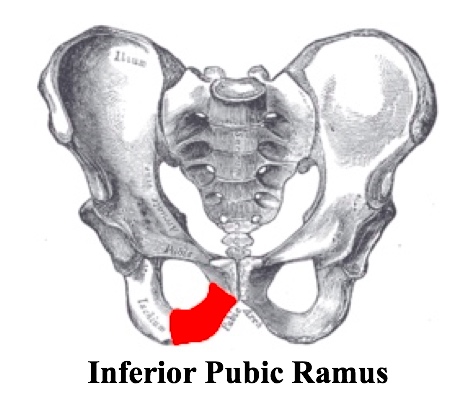
Yep, that old inferior pubic ramus up to its typical tricks. My small and scarcely noticeable jump resulted in a break, not unlike what happened to my friend years ago who broke his arm on the golf course executing a mildly average fairway drive. How does that even happen?
I can't speak for my friend's arm, except that there was some underlying weakness in the armbone that led to it snapping like a twig when he teed off.
In my case, the likely cause of the break seems to have been an absence of cancer. Somehow, a tumour had begun to grow in this area, the right inferior pubic ramus, and eat away at the bone itself. Then, the cancer treatment had begun to do its thing, so destroying the cancer and leaving behind itself a weakened bone structure. Then when I jumped into the air (six weeks ago), that is the exact moment at which some might say 'That's one small step for a man...one giant leap for a man with a weakened inferior pubic ramus, leading to a break that will ultimately cure itself with a bit of care and rest.' Such a saying lacks poetry but it does get across the essential details of what is going on.
So that's where we're up to. Please join me in praising God for working in this way to this point. Please ask that healing would continue. And please be assured of the truth of those wonderful Bible verses, 1 Peter 5:6-7, which read
Humble yourselves, therefore, under the mighty hand of God so that at the proper time he may exalt you, casting all your anxieties on him, because he cares for you.
In the meantime, here is a recent performance of another fabulous Ralph Vaughan Williams anthem, 'Come Down O Love Divine', all about the Holy Spirit's power in our lives. Pray it with me! And enjoy the other music, as led by Ross Cobb.
Monday 16 May 2022
I preached on the Holy Spirit
You can hear the sermon here from the 25 minute mark:
Three points:
1. The Holy Spirit is our Helper.
2. The Holy Spirit is a teacher of Truth
3. The Holy Spirit gives us peace.
The passage is John 14:15-31.
Thursday 12 May 2022
Would you join a club that wanted you for a member? (Cancer update 12 May)
In continued good news I am still putting on weight. Given the possibility of sudden weight loss I wouldn't mind getting a bit over my ideal. So long as it doesn't affect my sporting involvements.
I've been accepted in an Australian based bowel cancer support group on Facebook, a private group where people share their experiences and advice. To be honest I have mixed feelings about it. While my treatment is going well and my weight gain and stamina are improving (I'm having an experiment half day today at the CMS office—just avoiding peak hour public transport and making sure I stay within my energy limitations) I tend not to think too much about anything except the usual day-to-day obigations, family, work deadlines, preaching and congregational relationships.
But logging onto this cancer support group reminds me of some of the uncertainty of the situation I'm in. Just a couple of random quotes (it's a private group, so no names):
My cancer is back in my Liver, I had surgery last August on my liver and February this year on my bowel. We thought we had got it all, but it’s back.
or again
Hi All. I have asked my sister to post this on my behalf.It is with great sadness to advise you I have passed. I have been taken way too soon and the dreaded disease has done this. However I can say I fought, I’m unique to many in the medical world and defied all expected odds to have a beautiful extra months/years with the man I love, much loved family and friends.
Mark I love you …
Mum and Dad thank you for been the parents you were and are. I was lucky to have had youThank you to everyone who shared a special place in my world.. till we meet again

So sad. Some have good news, some don't. Some have surprising news of success, others don't. Discussions of reincarnation come up, effectiveness of particular treatments, side effects, the personalities of oncologists, messages of hope and despair. Perhaps at some stage I'll move beyond lurks and likes as I read these posts, at the moment it's just coming to terms with what the future may or may not look like.
Here are a couple of Bible verses that I carry with me most days (in my mind), and that help as I consider what lies ahead. Jesus said:
“Therefore do not be anxious about tomorrow, for tomorrow will be anxious for itself. Sufficient for the day is its own trouble." (Matthew 6:34)
and
2 Count it all joy, my brothers, when you meet trials of various kinds, 3 for you know that the testing of your faith produces steadfastness. 4 And let steadfastness have its full effect, that you may be perfect and complete, lacking in nothing. (James 1:2-4)
Those latter verses from James are good because they tell me that the bad things I might be going through, alongside my family (who are going through it just as much as I am, only in a different way) are nevertheless under God meant to be counted 'as joy'. What the word 'counted' suggests to me is a deliberate battle to reckon something as joy that really wouldn't normally be. But it can be counted as joy for a reason; that though it is experienced as suffering, yet under God it has a direct purpose and that is for our steadfastness until the day of perfection and completeness in Christ. Like labour pains, then, it won't feel happy or joyful but the end result will be both joy and happiness.
Speaking of Bible, I am preaching this Sunday at St Barnabas East Roseville. I'm preaching on the second half of John 14, which includes these marvellous verses:
18"I will not leave you as orphans; I will come to you. 19 Yet a little while and the world will see me no more, but you will see me. Because I live, you also will live. (John 14:18-19)
You can watch a livestream of the sermon at 11.00 this Sunday, here:
https://www.stbarneys.org.au/this-sunday-live-stream/
Or, if you are not committed at another church, come along at 9, 11 or 4.15 to the corner of William and Macquarie St, East Roseville—and make sure you say hello!
The passage is a great passage which reminds us that the Lord Jesus will never abandon us, no matter how great our extremity.
Meanwhile, Ralph Vaughan Williams' The Lark Ascending.
Wednesday 4 May 2022
I’m putting on weight! That’s good news. (Cancer update 4 May)
You work out what’s news by looking at the headlines. ‘Dog bites man’ is not news, ‘Man bites dog’ is. Actually when you think about it that’s wrong, but nevertheless…
So the headline is, ‘Cancer patient puts on weight’. Canadian comic Norm McDonald, who died of bowel cancer, talks with lack of enthusiasm about the book title ‘Lose weight without dieting or exercise!’ As he said, "doesn’t that just leave disease?"
Well yes and I got down to 71k, having lost 4k in the week
leading up to that measurement. Now I’m piling the weight back on and I’m up
to 76.9 as of today, about six weeks on. How’s that? My ambition is to get as
big as those guys who are confined to bed and can’t even get out of their room
until the guys with the chainsaws arrive to come through the external wall and
broaden the exit path out of the house and into the special crane-equipped
ambulance. Let’s see how we go.
So the doctor’s happy, I’m happy, and I will soon book in a
PET/CAT head to toe scan to see if my fingernails or any other body parts are
starting to grow their own tumours, but the vibe is that it’s all good so far.
Meanwhile, has it occurred to you that the antidote to despondency, over time, is thankfulness to God? Not an immediate cure, that's true, but today I am thanking God for putting on weight. Here is a song about feeling happy in such times.
Here's a particularly good version of the same:
Monday 25 April 2022
Reasons to be cheerful, part three
I said to Fiona (my first wife) that if people hadn’t heard from me, no news was good news. She reminded me that it could also mean that I was either dead or close to death. Yup ok. So due to overwhelming popular public demand, here is some news.
The cancer treatment is working very well, thank you. It’s not chemotherapy, which is good, because chemotherapy really means poisoning everything and hoping that the poison hits cancer harder than it hits teeth, hair, fingernails and parts of you that actually matter. The treatment is targeted therapy (BRAFTOVI) and as a result and after initial severe nausea, I’m stronger and healthier. I’m walking with a limp, because I tried to jump while playing with some kids at church. They are safe, their parents are safe, my leg hurts.
Despondency
When the likely possibility of death advances by 10-20
years, the initial response is ‘oh well’. Then, in my case, you start to think
of what is and what might have been.
At the age of 20 and if you have worked out that you are
good at things, you have the world open in front of you and even the parts that
you’ve chosen not to explore will wait. You are great (you actually are), your
achievements lie ahead of you, you can choose and whatever path you choose will
reveal greatness. You will not win Wimbledon but hey, you chose not to at age 8
and your regret is long past.
At age 60 you think hm, I now have a lot of regrets that are
long past, and some of them were quite important, and now due to a diagnosis I
could be gone in six months. The ‘so what’ response at age 20 has vanished into
the concrete of ‘uh oh. This could be it’.
Christ
My answer to my own despondency has been, so far, to feel despondent. But also to look to Christ. He is our great king. Every failure of ours is a victory for him (and therefore, for us), because as we trust in him and in his kindness, mercy, and grace, he wipes out our failure for eternity. And he reminds us that we, his little children, are doing exactly the things that he would want us to be doing, and that we are created for.
I am also reminded daily of the grace and kindness of friends. In your grace I see and experience the work of Christ himself. You did not need to ask after our family and our wellbeing. You did not need to pray or offer kindness in so many ways. And yet you have.
Other matters.
More to say, but let me immediately say that at this time: no news is actually good news. Treatment progresses. I am stronger and here is some proof, just a bit of Q and A after yesterday's sermon. Sorry about the collar malfunction, the rest of it I stand by.
And here is a song. Reasons to be cheerful, part three.
Sunday 3 April 2022
It is well with my soul. Is it well with yours?
This is what prevents me from worry.
Saturday 2 April 2022
Thankful as always for the kindness of friends (2 April)
All sorts of people have phoned or sent messages, some expected friends, some unexpected friends, some with memories from long ago. Here is a song for you, an old song that you may have heard before and I hope will hear again.
I'm feeling a lot better. The nausea has been whipped into shape and is now wishing its mother had never met its father. The BRAFTOVI treatment is working, as in, I have physical evidence that tumours are shrinking. Saw my oncologist Prof Clarke and he was pleased with progress, or in the case of tumours, regress. During the week of nausea I lost four kilos, I've put three back on and am eating lots. This weekend or soon after Matilda our eldest moves out to a room (that is larger than two of ours back here in our house) in the inner city; two other daughters have scored part-time jobs, and our dogs are happy thanks for asking. I walked up the steps at Meadowbank station two at a time and made it to the train, the hamstrings remain intact today. So many good things, or new things, or both.
Here are some thoughts that friends have shared, not necessarily with me in mind.
The first friend was considering COVID isolation and how, as many know say, it is not as bad as being a refugee from Ukraine or a flood victim in Lismore. Truth! But, said the friend, we are not necessarily helped by comparing suffering of one with another, and it is not how the Bible teaches us to think. Your stubbed toe is not as bad as Freda's amputation, but in the moment of pain and even after we are not competing with each other to see who is worse off.
And what if (as said friend said) the specific suffering we are going through is actually the means of God's blessing?
William Cowper wrote:
Ye fearful saints fresh courage take, The clouds you so much dread,
Are big with mercy, and shall break, With blessings on your head.
Are big with mercy, and shall break, With blessings on your head.
In other news, it's coming up to Easter, so here is a song about Easter.
The crucifixion itself was the lowest moment of all, yet through it the Lord Jesus' glory was revealed.
[as we learn in Acts 4:24-28]
And when they heard it, they lifted their voices together to God and said, “Sovereign Lord, who made the heaven and the earth and the sea and everything in them, who through the mouth of our father David, your servant, said by the Holy Spirit,
“‘Why did the Gentiles rage,
and the peoples plot in vain?
The kings of the earth set themselves,
and the rulers were gathered together,
against the Lord and against his Anointed’—
and the peoples plot in vain?
The kings of the earth set themselves,
and the rulers were gathered together,
against the Lord and against his Anointed’—
for truly in this city there were gathered together against your holy servant Jesus, whom you anointed, both Herod and Pontius Pilate, along with the Gentiles and the peoples of Israel, to do whatever your hand and your plan had predestined to take place.
Monday 21 March 2022
With apologies to all pregnant women at all times and in every place, 21 March update.
I'm not sure if I've ever said anything particularly rude or inconsiderate about pregnant women in the past, in fact I'm going to boldly assert that I haven't. But it may be (I'm really not sure) that in my mind I'd dismissed the idea of morning sickness and nausea as relatively trivial in the grand scheme of things, and for that I am now truly sorry to all women who have or will experience such a thing.
A hospital holiday

I spent last week in hospital (RNSH private) slowly recovering from severe nausea most likely induced by the targeted BRAFTOVI treatment I've been getting for my cancer. If the intestinal perforation I had a few weeks back was the worst pain I've ever experienced in my life, the nausea was the worst experience of sickness, especially sitting in emergency for several hours waiting for something, anything, to fix the feeling. Awful for Fiona to be with me and have to watch helplessly, too.
Nausea saps everything and puts a sick grey-green olive complexion on life, an overlay of not-quite-pain and disgusting negativity. Strength and concentration disappear, any happy thought of the future is underscored by an irrational notion that even the very best and brightest hope is somehow going to fail and be tainted by who knows what? This awful sick feeling that colours even sunlight with a sense that it will fade into darkness.
The hospital emergency nurses are hardcore—they have their clear instructions on what they are able to give in the way of drug treatment, and quite rightly they follow them. So if there is some temporary relief that they are able to provide, and that relief starts to fade, then it will be (say) two hours before any further drug help can be given. In the meantime they will be reasonably sympathetic whilst suggesting that you stop moaning and relax into it, as this will probably last all night and the best way to avoid the worst symptoms is to sleep. Let me tell you that the advice hurts almost as much as the nausea, and the suggestion to maybe not moan quite as much during the worst moments.
Really, nothing at all against emergency nurses but to get admitted into the actual ward is to experience the joy and relief of the oncology team saying 'you can have as much nausea relief as you want, whenever you want it, and if it's not enough, just ask!'
Nausea shoots great holes in the strength to do the most routine things in life and removes the ability to think all but the most basic thoughts. You can lie for hours doing nothing and imagining nothing, planning nothing and hoping vaguely that the situation might improve in a few hours or days. Pregnant women everywhere, I salute your strength.
Today? Feeling OK
By Friday of last week I felt pretty good and had almost started to enjoy my hospital holiday. Although I did lose about four kilos in the course of a week, and that's not great, hey. The oncologist apologised for making me sick with his treatment—hardly his fault really. My dad picked me up (Fiona was not feeling the best) and took me back to his place. In a desperate desire for carbs that were not also hospital food and involved some activity on my part, I made spaghetti carbonara for both of us. Missed a wedding on Saturday. Made it to church on Sunday. Now it's Monday and brain and body seem to be operational enough to make it to a morning Bible study and get on with my editing work at CMS. Let us see.
In the meantime I am deeply aware of the goodness of God in providing medical people who are able to navigate this path alongside me, and the ongoing kindness of family, friends, and church family. Some people phone, some leave comments on my Facebook page, many provide support in ways small and large.
To experience this is to experience a direct epiphany of the grace of God who works all things for the good of those who love him and are called according to his purpose (Romans 8:28). Sometimes—often—I can't respond to these kindnesses shown by so many and in so many ways. If you're someone who has called, prayed, offered help, then please know that your kindness is known and felt deeply even when not responded to in any way that you may be aware of. Such grace reminds me that even in the face of the worst nausea or pain, there is a true solidity and basis to this instruction God gives to all who trust him:
Count it all joy, my brothers, when you meet trials of various kinds, 3 for you know that the testing of your faith produces steadfastness. 4 And let steadfastness have its full effect, that you may be perfect and complete, lacking in nothing. (James 1:2-4)
The daily experience of the grace and kindness of friends is just one dimension of the joy that comes to all God cares for.
Oh yes and I'm back today on my targeted BRAFTOVI cancer treatment, at a lower dose and bolstered by lots of anti-nausea options. Let's see what happens!
Saturday 12 March 2022
Sleeping on steroids, a new treatment (March 12)
Due to overwhelming popular demand, another cancer update!
I am home with Fi and the girls now and have been for about a week, following a time with my dad, following a time at RNSH hospital, following emergency surgery after the cancer perforated my bowel, which is every bit as painful as it sounds. But I woke up feeling a lot better and after ten days in hospital my dad took me not home, but to his place, whilst two daughters tag-teamed COVID and the family spent time in isolation, while I isolated from them.
My dad took great care of me and I spent a good deal of time sleeping, or vaguely watching a survival series called 'Alone', where intrepid individuals doing their own camera work are dropped into some serious wilderness and left to fend for themselves in cold, wet, and frequently miserable conditions along with wolves, bears, and cougars. A bit like me, really, except without the predators, and I had hospital care, and with my dad then looking after me and providing lobster, prawns, steak, pork fillet, stir fry and whatever else he decided to cook up for the night. But hey, Sydney has been cold and wet hasn't it? And I was alone in my room, so I did sympathise with those poor survivalists.
Alone... o ja ...
OK it wasn't so lonely as all that, but I was surprised (after doing pretty well in hospital, including being able to walk around and keep working) that I was so worn out for so long. Yes it was major surgery, and I now have a scar to compare to Fiona's caesarean scar, along with other accoutrements of the procedure (colostomy bags, anyone?) and a collection of drugs that just keeps accumulating, despite my best efforts to consume them.
A new treatment
And now I'm home, propped up by sleep and steroids and the loving care of Fiona and daughters. That's nice! I even managed to preach at church about two weeks ago, want to see? Here's the link, go to 33min 30sec for the reading, followed by me preaching on 1 Thessalonians 2.
It's about warm family relationships, amongst other more important questions. And it gets a bit rambly. But hopefully in a fun and helpful way.
Back to the new treatment. They can't give me chemotherapy straight away, if they do it not only attacks the remaining cancer but (to a lesser extent) the rest of the body, which is not so good for healing of surgery-induced wounds. But in the providence of God, a therapy targeted specifically towards the sub-type (actually mutation, look up BRAF) of colorectal cancer that I have has come available. This therapy was, until January this year, extremely expensive, c. $6000 a month. Now, courtesy of the Australian Pharmaceutical Benefits Scheme, it comes at no cost to me, and is potentially a better way of tackling the cancer than chemotherapy. If you want to get the medical and nerdy details of this therapy, it's called BRAFTOVI, and here it all is (or at least, a good starting point).
Yes there are side-effects, especially I've had a fair bit of nausea. And I'm still very tired and run out of energy easily. Steroids help with nausea and as a nice side-effect, they kick-start my brain into the action needed to do a bit of work. But there is a fair bit of time spent walking extremely slowly, sitting slumped and sleepy, or just lying down.
Update March 13: Oh boy, did I get sick yesterday! Painful nausea from the BRAFTOVI therapy (I think that's what was going on) and straight into RNSH hospital where I remain. Not sure what happens now, but it was not a fun night.
Saturday 26 February 2022
Journey home part the second 26 February
This is me leaving hospital on Friday. Apparently the wheel chair was compulsory, though I'd offered to walk and help push.

I'm not actually home yet. Staying with my dad, because we have a confirmed COVID case in the family and it's good for me not to be close by. This morning another daughter confirmed positive, so it doesn't look like I'll be back home for at least a week. In this tag-team COVID-catching time, this process could extend.
In the meantime, want to join me at church? I'm preaching tomorrow on 1 Thessalonians 2. It will be the best sermon you have heard on 1 Thessalonians 2 for many days, and it is an insight into the power of the gospel of God to transform lives in the face of adversity and with great glory to him. You can join us live, or later, by clicking through: https://www.stbarneys.org.au/this-sunday-live-stream/
Also a better version of this song, I am waiting to hear. I know that my Redeemer lives:
Wednesday 23 February 2022
The long trudge home 23 February
This is me, exercising by walking around the hospital ward with the other COVID-isolated inmates. No not really, but I shall be released tomorrow--not to go home, because I will be staying with my dad, given that our family is in COVID isolation with one daughter having caught COVID for the second time.

Art of the Day: Van Gogh, Prisoners Exercising (after Doré), February 1890. Oil on canvas, 80 x 64 cm. Pushkin Museum, Moscow.
All appears to be well, no sign of infection and doctors happy. I'll be preaching at church this Sunday, God willing, on 1 Thessalonians 2. But unlikely to see the rest of the family in person until Tuesday next week.
The next chemo cycle is 2-3 weeks away, yet to be determined and somewhat dependent on how well I recover from the current surgery. Like the men in Van Gogh's prison yard, just keep moving.
Meanwhile, sing with me and Bob. "I shall be released"
Tuesday 22 February 2022
Jesus loves me at the other end of life. 22/02/22.
Not too much to report. Jabs and pills. Waiting on results, maybe I'll go home tomorrow. In the meantime, whether you are great or small, Jesus loves you!
Sunday 20 February 2022
Jesus in the face of death
I work at CMS (Church Missionary Society) as an editor, and the International Director there is Peter Rodgers. I've been so thankful that during this time of illness I've just been able to keep on working from home or even from hospital, as the case may be. CMS as employers have been incredibly fair and supportive in finding ways for this to continue.
I mention this as background to something completely different, which is how Jesus responded to news of his friend Lazarus' imminent death. Here is just a little of the story, from John 11, that sets up the scene:
After saying these things, he said to them, “Our friend Lazarus has fallen asleep, but I go to awaken him.” The disciples said to him, “Lord, if he has fallen asleep, he will recover.” Now Jesus had spoken of his death, but they thought that he meant taking rest in sleep. Then Jesus told them plainly, “Lazarus has died, and for your sake I am glad that I was not there, so that you may believe. But let us go to him.”It's well worth reading the whole chapter, in which Jesus is implicitly rebuked for his slowness in coming to his friend's side. Surely he could have prevented the experience of death that he now witnesses firsthand? But he hasn't come in time (or so it seems), therefore he weeps.
The afore-mentioned Peter Rodgers wrote a brief piece about how Jesus responds to his friend Lazarus' death. It is a response that by clear implication shows us something of how we, too, can face the reality of the deaths of those around, or even our own.
In his short article Peter asks this key question: Why did Jesus weep?
Weeping is normal at the death of a loved one. In some cultures, weeping is done almost in private, and expressions of grief are muted. In other cultures, a public display of weeping is important, even to the extent of employing professional mourners.
In John 11, when people hear the unexpected news of Lazarus’ death there are natural expressions of grief.
“When Jesus saw her (Mary) weeping, and the Jews who had come along with her also weeping, he was deeply moved in spirit and troubled. “Where have you laid him?” he asked. “Come and see, Lord,” they replied. Jesus wept.
The expressions of grief from Mary and Martha and the others with them are expected.
But why does Jesus weep?
Jesus already knew that Lazarus had died and what he would do for the sake of God’s glory (verses 4,14,15). So, if Jesus knew he would raise Lazarus from the tomb, why does he weep?
There are some lessons we can learn.
Jesus is not indifferent to suffering. He loved Lazarus (verse 5). We see here the great heart of Jesus: the Son of God, God himself—weeping, sobbing—at the death of his friend, and the grief it has caused his other friends. This is the normal and right response to death – even for Christians. For whilst we do not grieve like the rest of the world, we still grieve. Here we see that weeping is a right response to death. And the Son of God has so entirely entered into humanity that this includes entering the depths of sorrow. Jesus wept.
But Jesus does not weep out of despair as we might. In verses 25-26 he has already declared these magnificent words.
“I am the resurrection and the life. The one who believes in me will live, even though they die; and whoever lives by believing in me will never die.”
Unlike us, Jesus is not powerless. Jesus proves the truth of these words by calling Lazarus out of the tomb!
It may seem odd to us that someone who has the power to raise people from the dead should weep. Odd that Jesus can be all powerful and yet burst into tears. This is the mystery of the person of Jesus – who is man and God. We don’t need to spiritualise away his tears and anger. We need to accept he is God, but still fully a man. He trembles in anger, weeps in sorrow and then raises the dead with a shout.
Eight chapters later the Jews will be shouting for Jesus’ death.
Of course, Lazarus grew old and died again. His resurrection, as amazing as it was, is just a shadow, a glimpse of what happened just over a week later when Jesus was crucified and his dead and mutilated body laid in a tomb. And three days later he rose from the dead, once forever, never to die again. Jesus is literally “the resurrection and the life”. These were not empty words spoken just to comfort people in their grief. These are life giving words spoken by the only person in all history to have defeated death and now live forever.
At a basic level, Jesus' tears should encourage us to weep with those who weep. We should allow grieving people to feel right anger at death and suffering. In fact, death and suffering should make us indignant wherever we see it. We need to become better carers of those who suffer. Christians who know that we have a God who has wept at death should never be indifferent to death.
But more so, although in the face of death we are powerless, we can point grieving people to Jesus, who not only grieves with them, but is himself the resurrection and the life.
The Christian response to death and dying is not stoic acceptance. Nor is it a triumphalistic lack of awareness, nor even a resigned despair. It is exactly and precisely the response Jesus gave: to weep over its horror, and to trust to the power of God to completely reverse and upend and defeat its power over us.
As I'm writing this blog post on a Sunday, how about you join me in singing this hymn? Or scroll down to the video and let the Welsh do it for you.
1. Guide me, O Thou great Jehovah,
Pilgrim through this barren land.
I am weak, but Thou art mighty;
Hold me with Thy powerful hand.
Bread of heaven,
Feed me now and evermore;
Bread of heaven,
Feed me now and evermore.
2. Open now the crystal fountain,
Whence the healing waters flow;
Let the fire and cloudy pillar
Lead me all my journey through.
Strong Deliverer,
Be Thou still my Strength and Shield.
Strong Deliverer,
Be Thou still my Strength and Shield.
3. When I tread the verge of Jordan,
Bid my anxious fears subside;
Death of death, and hell's destruction,
Land me safe on Canaan's side.
Songs of praises, I will ever give to Thee;
Songs of praises, I will ever give to Thee.
Saturday 19 February 2022
What a noisy hospital

Yes, visiting here in hospital has been highly restricted but possible. Only one visitor per day. And of course phone calls.
I’m not entirely unhappy about the visitor restrictions. The medical people here are terrific but the environment itself is incredibly noisy.
That doesn’t bother me, as sleeping anywhere, anytime is one gift that I feel God has given me to offer the church—or indeed any context that I find myself placed in.
But to add troops of visitors into the mix? Heavens to Betsy! My own visitors I could handle. When everyone in the public ward gets visitors, that is a lot of people. And so many people here seem to appreciate shouting and being shouted at, including amongst the hospital staff. I know this because in the absence of many visitors, people ring their relatives in hospital and shout at them. Not angry shouting. Just shouting. This I am not understanding. It does however seem to bring some measure of comfort and cheer to those being shouted at.
Perhaps in these COVID restricted times it could be a ministry some churches could become involved in: offering to ring up sick people in hospital and shouting at them.
“I was hungry and you fed me. Naked and you clothed me. In hospital and you rang me up and shouted at me.”
Think about it. In these COVID times, this idea has legs.
Wednesday 16 February 2022
15-16 February pain followed by gain.
[This is from my 15 February Facebook post, transferred here and updated for sake of completeness]
15 February. Slightly rushed health update. Intense pain in the middle of last night related to constipation and internal plumbing. Ambulance trip to RNS Public to find answers. Pain well controlled and about to see surgical team to discuss options in light of CT Scan results. To me, and this is pure speculation, the options are not likely to concern whether or not I get ice cream for dessert tonight, but more about whether some kind of surgery is about to happen.
Who knows? Well, God does and that is good enough for me. If you are the sort of person who prays, you know what to do!
Thanks for those who comment and pray in various ways. Please know that I love reading what you have to say but responses are likely to be hit and miss. Generally I will put the latest onto my blog but just occasionally, like today, FB is probably the best way to go.
Praise God from whom all blessings flow.
Update #1 on basis of CT scans, emergency surgery would normally follow at this point. Couple more consultations required first.
Update #2. Bowel cancer has perforated. Emergency surgery for perforated bowel about to happen.
Update #3 surgery has happened. I don’t know what I was expecting but I feel surprisingly well. Colostomy, catheter, button for self-regulated pain relief, beautiful family and many friends, and above all, a hot line to the one who made all things in Christ, in whom all things hold together. God hears and answers prayer.
Update #4 surgical team dropped in just now, 7.30 am on 16 February. They were happy with progress.
Thanks to those praying and sending messages. They mean a great deal. And I’ve been reminded of the Heidelberg catechism of 1563. Check out question 1 below:
Q. What is your only comfort
in life and in death?
A. That I am not my own,1
but belong—
body and soul,
in life and in death—2
to my faithful Saviour, Jesus Christ.3
He has fully paid for all my sins with his precious blood,4
and has set me free from the tyranny of the devil.5
He also watches over me in such a way6
that not a hair can fall from my head
without the will of my Father in heaven;7
in fact, all things must work together for my salvation.8
Because I belong to him,
Christ, by his Holy Spirit,
assures me of eternal life9
and makes me wholeheartedly willing and ready
from now on to live for him.10
[The Heidelberg Catechism, 1563. Q and A 1]
1 1 Cor. 6:19-20
2 Rom. 14:7-9
3 1 Cor. 3:23; Titus 2:14
4 1 Pet. 1:18-19; 1 John 1:7-9; 2:2
5 John 8:34-36; Heb. 2:14-15; 1 John 3:1-11
6 John 6:39-40; 10:27-30; 2 Thess. 3:3; 1 Pet. 1:5
7 Matt. 10:29-31; Luke 21:16-18
8 Rom. 8:28
9 Rom. 8:15-16; 2 Cor. 1:21-22; 5:5; Eph. 1:13-14
10 Rom. 8:1-17
Saturday 12 February 2022
Red pill, blue pill. 12 February.

Oh wait. Different book, different story. I meant to talk about pills not sheep.
The first cycle of chemotherapy hit pretty hard, as friends in the know predicted. Lots of sleeping, some nausea, a return to hospital after a temperature spike, and a brain that functioned in grooves or not very well. If I could hunt down a thought I could follow it through but sometimes lacked the energy to do a task I'd set for myself that day, then ran out of puff and did a lot more sleeping.
The visit to hospital was good (I'm out now) and took pressure off the family, and I want to find ways to keep helping them as they help me. Sometimes that will mean occasional visits to stay at my dad, sometimes other things. Fiona has been wonderful and continues to be so.
What I'm currently finding entertaining and informative is the number of pills that I've been loaded up with for the treatment of various side-effects (tiredness, nausea, constipation, not-constipation, possible infection, inflammation, pain) on top of the full range of possible chemotherapy options and injections of unnamed substances.
It is very confusing, especially initially, because some of the treatments and subsequent treatments for side-effects have opposite effects and, in any case, require you to have at least a sense of what's going on.
Example, the steroids (to damp down inflammation) also can produce wakefulness and fast-paced thoughts, which can occasionally overcome the tiredness induced by chemotherapy. That's fine, and sometimes useful if you've been sleeping all day but suddenly get a burst of brain activity that allows you to work away for a few hours at night. The ideas flow freely, even manically and if it is for work-related writing that is good at the stage where you're drafting ideas. Then some sleep and as the steroid effect wears off, the brain slows down to a level where it is able to edit the incomprehensible brilliance you've produced into a form that a reasonable third party could begin to understand.
If you can understand that cancelling or opposing set of pill-effects as it relates to the thought processes, then you can use your imagination to extend the metaphor to other and lower bodily functions. The red pill is going to help you with side-effect X brought on by the painkillers. But before you had side effect X, you were suffering from symptom Y, which is actually the opposite of side effect X, so that's good right? Well sort of, except you weren't expecting side effect X, so you did what was advised and took the blue pill to help with symptom Y.
So you're sitting there, having been discharged from hospital, with the red pill and the blue pill. Each is potentially useful, even necessary. But they cancel each other out and you're not quite sure which one to take.
My solution just at the moment is to dump all the pills in one bag, and pick the one that I personally prefer at any given point, allowing for actual instructions and warnings about not taking too much. A lot of the time the actual instructions say something like 'take as needed and not if not'. So even though my approach sounds random, it fits within the best current medical advice available to me. Maybe it's a bit like with those night-and-day cold and flu tablets, where I figure that if you've got a very runny (non-COVID) nose, you just take one of each and the hype-up effects of one will be cancelled by the hype-down effects of the other.
This has turned into quite a long post, relative to the others. Looks like the brain-hyping steroid I took a few hours ago is doing its thing. Hyping leads to typing. Please respond in the comments therefore if you think this post needs a bit of subdued editing or at least the addition of subheadings. I find that if enough people comment, the advice cancels itself out and just like the pills, I can pick and choose out of what's there. So have at it!
"Thou wilt keep him in perfect peace, whose mind is stayed on thee: because he trusteth in thee." (Isaiah 26:3, KJV)
Thursday 10 February 2022
Waiting music--home today? 10 February
Today, more antibiotics and more blood tests. If everything's clear, then back home from hospital.
Meanwhile here's Orlando Gibbon's version of Psalm 47, O clap your hands (with no clapping. As great as the British choral tradition is, they weren't going to go that far).
O clap your hands together, all ye people, O sing unto God with a voice of melody. For the Lord is high, and to be feared, he is the great King of all the earth. He shall subdue the people under us, and the nations under our feet. He shall choose out an heritage for us, ev'n the worship of Jacob, whom he loved. God is gone up with a merry noise, and the Lord with the sound of the trumpet. O sing praises, sing praises unto our God, O sing praises, sing praises unto the Lord our King. For God is the King of all the earth, sing ye praises with understanding. God reigneth over the heathen, God sitteth upon his holy seat. For God, which is highly exalted, doth defend the earth, as it were with a shield. Glory be to the Father, and to the Son, and to the Holy Ghost, As it was in the beginning, is now, and ever shall be, world without end. Amen Words from Psalm 47
Update: I’m home, with another little bag of pills. Today’s featured drug is Endone. I like this one!
Subscribe to:
Posts (Atom)